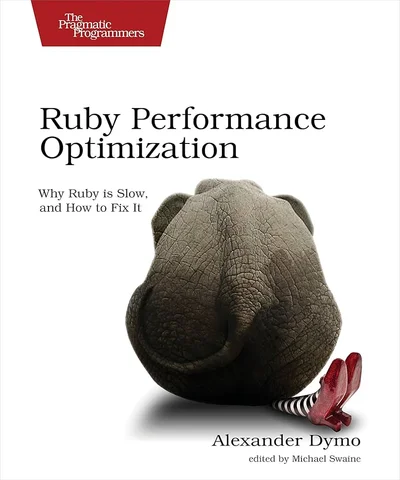
Ruby Performance Optimization: Why Ruby Is Slow, and How to Fix It
Alexander Dymo
"The definitive Ruby performance bible. Core insight: 80% of slowness comes from memory and GC, not algorithms. Published in 2015 but the mindset is timeless."
Ruby Performance Optimization by Alexander Dymo is the first comprehensive resource to consolidate all Ruby performance knowledge into a single source. The author brings over 8 years of hands-on experience optimizing Ruby/Rails applications in real production environments.
On Goodreads, the book holds a 4.07/5 rating from 55 reviews — not a blockbuster number, but those who have read it rate it highly.
The Core Mindset: Why Is Ruby Slow?
Before reading this book, I — like many developers — assumed Ruby was slow because it’s “interpreted” or “not C++”. Dymo completely overturns that assumption.
The book’s central thesis: Ruby is not slow because of algorithms or language architecture. Ruby is slow because of excessive memory consumption, which forces the Garbage Collector (GC) to trigger constantly — potentially consuming more than 50% of a program’s execution time.
Dymo’s golden rule:
“What is not allocated does not need to be collected.”
This mindset fundamentally changes how you look at Ruby code. Instead of asking “is this code correct?”, you’ll start asking “how many unnecessary objects does this create?”
Chapter-by-Chapter Breakdown
Chapter 1 — What Makes Ruby Code Fast?
The opening chapter builds the Performance Mindset. Dymo presents the 80/20 rule: 80% of performance improvements come from memory optimization, the other 20% from everything else.
Key insight: a program that manages memory well will run fast on every version of Ruby, regardless of whether a newer GC is available.
Chapter 2 — Fixing Common Performance Mistakes
The most hands-on chapter in the first section. Specific techniques include:
- String optimization: Use “bang” methods (
gsub!,downcase!) and the<<operator to mutate strings in-place, avoiding unnecessary copies. - File reading line by line: Replace
File.read(loads entire file into RAM) witheach_lineorgetsto dramatically reduce peak memory. - Beware of Closures: Proc/lambda objects can hold references to the entire execution context, silently causing memory leaks.
- Choose iterators carefully: Some iterators like
each_with_indexcreate more temporary objects than you’d expect — be deliberate inside large loops. - Push heavy work outside Ruby: Handle intensive computation at the database layer (SQL) or use C-extension gems instead of pure Ruby.
Chapter 3 — Making Rails Faster
This chapter focuses on Rails — the environment most Ruby developers work in daily.
ActiveRecord is the biggest memory consumer. Principles:
- Only
selectthe columns you actually need. - Use
includesto prevent N+1 queries. - Use
find_each(batch processing) instead of loading thousands of records at once.
Action View: Rendering partials inside a loop is expensive because each iteration initializes a new template object. Solution: render collection: @objects lets Rails initialize the template only once.
Chapter 4 — CPU Profiling
The golden rule when profiling: disable GC before running a CPU profiler to eliminate noise from GC running at random intervals.
Tools: ruby-prof + KCachegrind to visualize Call Graphs. The book walks through reading three report types: Flat (lists the slowest methods), Graph (call relationships), and Call Stack (execution tree).
Chapter 5 — Learning to Optimize with a Profiler
A hands-on chapter following this iterative workflow: Write Test/Benchmark → Profile → Hypothesize → Optimize → Re-profile.
Key lesson: not every optimization works. Sometimes you need to restructure code at a higher level — like removing Regex, handling strings manually — to achieve real gains. The book’s worked example achieves a 4.7x speedup after optimizing in the right place.
Chapter 6 — Memory Profiling
Introduces Valgrind Massif and Stackprof for tracking heap usage over time. Also covers using GC#stat — Ruby’s internal API — to understand what the GC is doing behind each request.
Chapter 7 — Measuring Correctly
How do you ensure benchmark results are trustworthy? Dymo covers eliminating external factors (OS cache, I/O) and applying basic statistics (standard deviation, confidence intervals) to distinguish genuine improvements from random noise.
Chapter 8 — Performance Testing
Optimizing once is not enough. Dymo walks through writing automated performance tests (using the assert-performance gem) to ensure future code changes don’t cause regressions. The section on tracking SQL query counts inside integration tests is particularly practical.
Chapter 9 — Thinking Outside the Box
Three interesting infrastructure-level techniques:
- Process cycling: Restart processes periodically when accumulated memory gets too high.
- Forking: Run heavy tasks in a child process; once done, all memory is immediately returned to the OS.
- Out-of-Band GC (OOBGC): Run GC when the server is idle, avoiding interruptions during active request processing.
Chapter 10 — Garbage Collector Tuning
Deep-dives into Generational GC introduced in Ruby 2.1+. Covers tuning environment variables like RUBY_GC_HEAP_GROWTH_FACTOR to optimize GC behavior for your application’s specific workload.
Strengths
- Comprehensive and systematic: The first book to consolidate all Ruby optimization knowledge into one source.
- Highly practical: Techniques drawn from years of real-world experience, not academic theory.
- Clear learning path: Guides readers from “performance rookie” to “performance expert” in logical steps.
- Mindset shift: After reading, you’ll instinctively think about memory allocation every time you write Ruby.
Weaknesses
- Published in 2015: Some content on GC internals (particularly environment variables) may be inaccurate for Ruby 3.x. However, the core mindset and general principles remain fully valid.
- Covers Ruby 1.8: Some examples reference old versions, making certain sections feel historical rather than immediately practical.
- Not universally applicable: Some techniques only make sense when you’re processing large datasets or handling high traffic.
Community Reviews
| Reviewer | Review |
|---|---|
| Jeffrey Dill | ”Not everything will be useful to you, but this is a must-read for any Ruby developer.” |
| Johnny | ”Great book. Top tip: reduce memory allocation — what is not allocated doesn’t need to be collected.” |
| Matthias | ”Solid book, a great starting point for the topic. Well worth the price.” |
| Matt Margolis, Getty Images | ”A must-have for anyone bringing performance-sensitive Ruby programs to production.” |
Who Should Read This?
This book is best suited for intermediate to advanced Ruby/Rails developers dealing with real performance problems in production: high server costs, slow response times, or memory usage that grows over time.
If you’re new to Ruby, come back after at least 1–2 years of hands-on experience — the book will be far more meaningful once you’ve felt the pain of a sluggish Rails app firsthand.
The eBook is available on Pragmatic Bookshelf for approximately $19–$31 USD.