Degrees Becoming Worthless in the AI Era: What Learning Actually Means
AI commodifies results. But it doesn't commodify the process of becoming a better human being. That's the real value of learning.
AI commodifies results. But it doesn’t commodify the process of becoming a better human being. If you ask the question directly, “Does AI make degrees useless?”, my answer is: AI weakens the signaling power of degrees, but it does not erase the real value of learning.
That’s why the conversation around degrees and education today causes so much confusion. A clothing vendor or car washer can ask AI and get answers that used to require specialized textbooks. If you only look at the final output — a piece of code, an analysis, an essay — the gap between formally trained individuals and untrained ones seems to narrow.
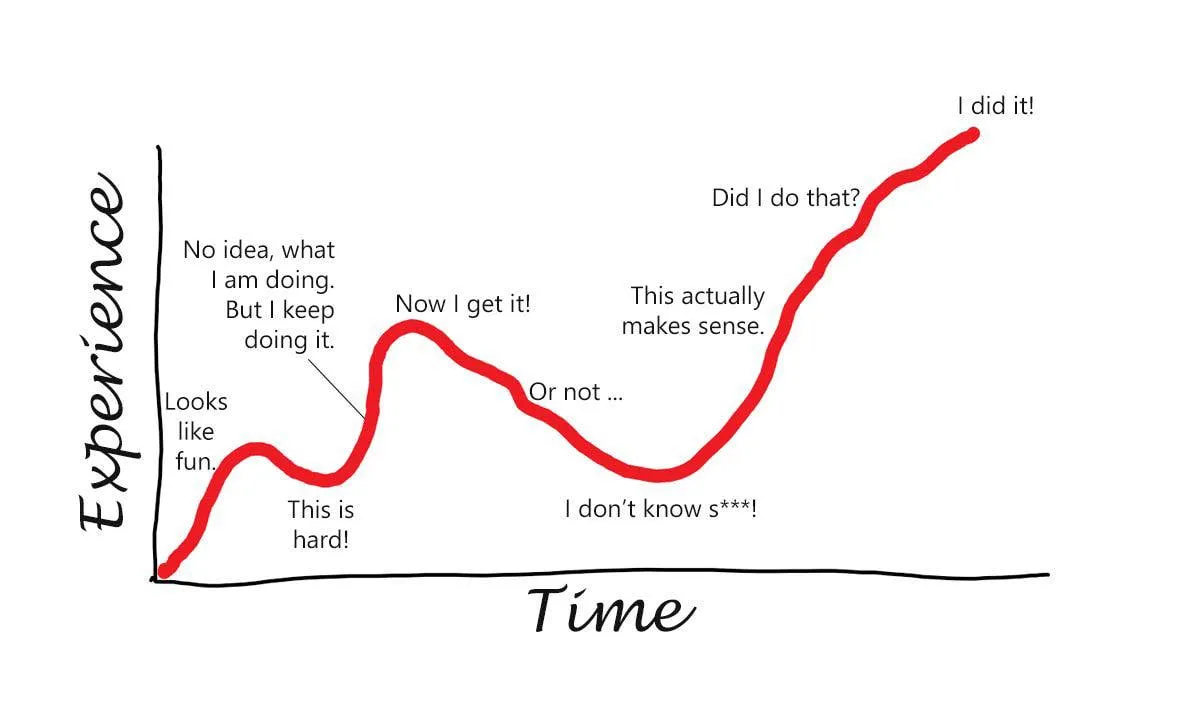
But what matters has never been about the final output. It’s about what we call the learning curve.
The Learning Curve: Restructuring the Human
The learning curve isn’t about memorizing knowledge. It’s the process of your brain and your very being getting restructured.
Take a simple example: learning to drive. You can watch a hundred tutorial videos. AI can perfectly describe every single motion. But the first time you sit behind the wheel, your hands shake, your feet fumble, your mind overloads. After dozens of hours of practice, your body begins to automate: eyes scan the road, hands steer, feet modulate gas and brake without conscious thought. You have changed. You don’t just “know” how to drive — you have become someone who can drive.
Learning to code is the same. Someone using AI can produce working code. But someone who has gone through the learning curve of programming develops intuition: knowing how to break down problems, anticipate bugs, design systems. The difference isn’t in today’s code, but in the ability to solve problems you’ve never encountered tomorrow.
Or learning piano. AI can play a piece perfectly. But someone learning piano must go through thousands of hours of finger exercises, correcting tiny mistakes, building concentration and musicality. The final product might sound identical to casual listeners. But only one side has undergone internal transformation.
That is the true value of learning: transforming the person.
Degrees: A Signal Losing Value
Degrees used to hold value because they signaled that someone had completed a difficult learning curve. But when AI allows many people to “shortcut” to results without the process, the value of degrees comes into question.
Not because learning becomes useless, but because the degree no longer guarantees that real transformation has occurred.
The New Divide: Two Ways to Use AI
AI creates a clear division.
The first group uses AI to avoid the learning curve: they achieve fast results but their foundational capability doesn’t grow, becoming increasingly dependent on the tool.
The second group uses AI to accelerate their learning curve: asking deeper questions, experimenting faster, understanding the essence of problems.
The gap between these two groups will only widen.
The first group can produce something today. But when facing new problems, they wait for AI again. The second group builds the capacity to solve problems that AI hasn’t been trained on yet.
If you want to see this divide through the lens of an early-career developer, When the Compass Hasn’t Appeared Yet: the early-career stage without clear direction is a natural companion piece. If you want to zoom out and see how AI changes work itself, read AI Doesn’t Replace a Whole Department: how AI restructures workflows.
21st Century Education: Learning Capacity, Not Fixed Knowledge
In the last century, education primarily prepared people for a stable career. In this century, the core value of education is building the ability to continuously climb new learning curves.
Not knowing a specific skill, but having the capacity to learn new skills quickly and deeply.
Therefore, the question is no longer “Will AI replace learning?” The better question is: Are you using AI to avoid the process of becoming a better human, or are you using it as a tool to accelerate that process?
AI can give you answers. But only the learning curve gives you capability.
A question to reflect on: When was the last time you completed a difficult learning curve? And how did you change after that process?
Frequently asked questions
Does AI make degrees completely useless?
Not completely. AI makes outputs easier to produce, so degrees are a weaker signal than before. But disciplined learning, deep understanding, and problem-solving ability still matter a great deal.
What is the real value of learning in the AI era?
The real value of learning is that it changes the person doing the learning. It builds judgment, resilience, and the ability to solve unfamiliar problems instead of only producing familiar outputs.
How should people use AI without becoming dependent on it?
Use AI to speed up research, experimentation, and feedback, not to skip the entire learning curve. If AI becomes your substitute for thinking, your surface output may improve while your actual capability stalls.
Related reading
personal
Energy Management After 8 Hours at the Office: Why Your 3 Evening Hours Matter Most
A personal story from an IT worker who spends 8 hours at the office and 3 hours on the road, and how managing energy (not time) is the key to avoiding lifelong procrastination and stagnation.
personal
AI Doesn't Replace a Whole Department — But It Can Automate 60–70% of the Work
Generative AI can automate most repetitive tasks; one person who can design processes and orchestrate AI can deliver the output of an entire team. A compact view of past, present, future, and how to run a virtual department on AI.
personal
When the Compass Hasn't Appeared Yet: The Grit of a Young Developer Steering Alone
When no mentor is around, you can still grow fast by learning independently, asking better questions, and building discipline every day.