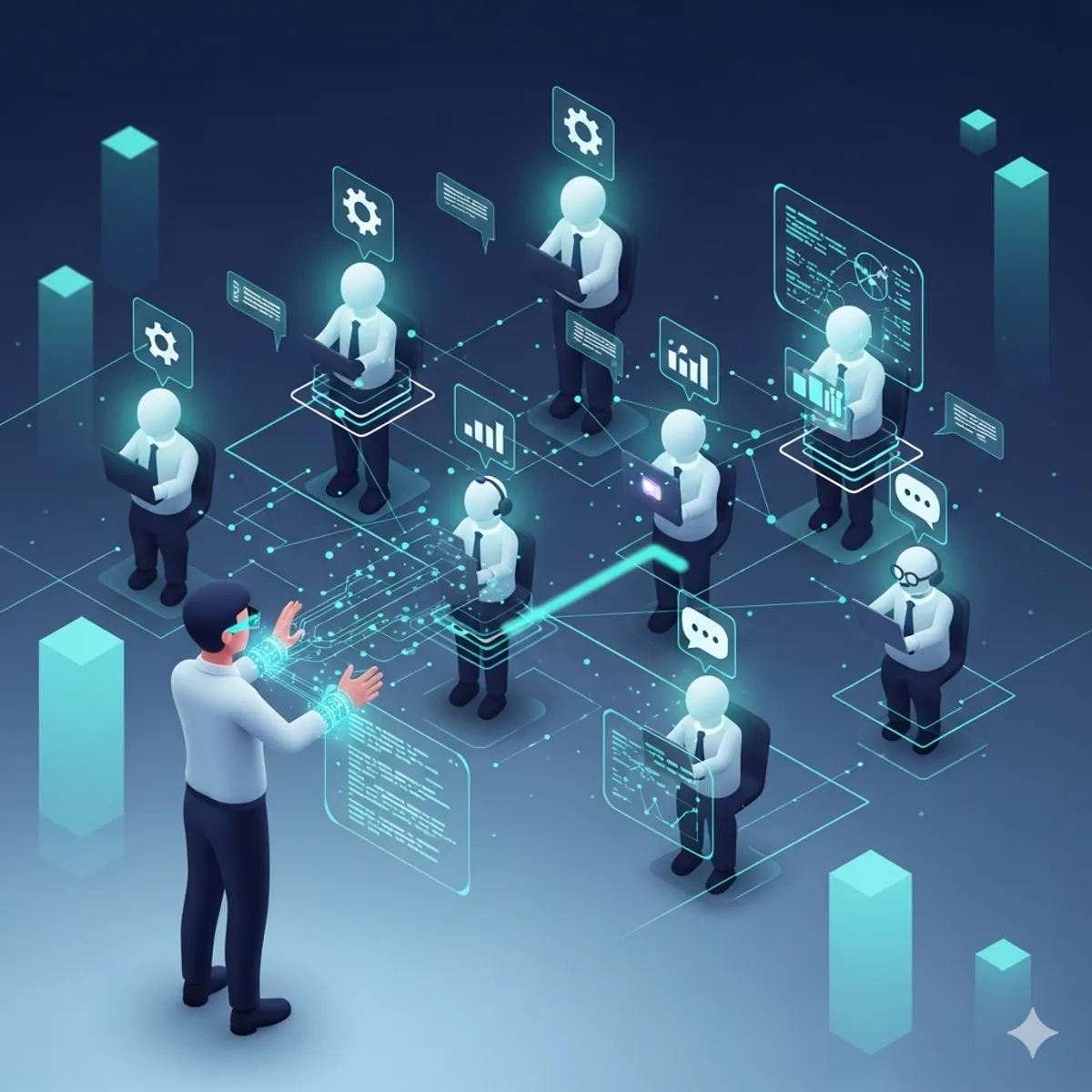
AI Doesn't Replace a Whole Department — But It Can Automate 60–70% of the Work
Generative AI can automate most repetitive tasks; one person who can design processes and orchestrate AI can deliver the output of an entire team. A compact view of past, present, future, and how to run a virtual department on AI.
In short: AI doesn’t “replace a department wholesale,” but it’s already powerful enough to automate 60–70% of the day-to-day workload in many office roles. Anyone who can design workflows and “orchestrate” AI can outperform an entire team. This post treats the topic as a compact, evidence-based take with a personal angle: past, present, future, then a concrete “how” for turning AI into a “virtual department.” McKinsey
Short answer
Can AI replace an entire department? Not literally in most cases, but it can automate a large share of repetitive, rules-based, information-heavy work. In practice, the more realistic model is one capable operator plus a well-designed AI workflow replacing the output of a small team for specific functions.
What “AI Replacing a Department” Actually Means
McKinsey estimates that, when generative AI (e.g. GPT) is combined with other automation technologies, 60–70% of current working hours could be automated in a technical sense—mainly information processing, synthesis, writing, and analysis. That doesn’t mean 60–70% of staff get laid off overnight; it means most tasks in a role can be handed to the system, while humans shift to strategy, complex communication, and decision-making. McKinsey
Goldman Sachs adds that about two-thirds of current jobs have at least some tasks that qualify for AI automation, and up to a quarter of current work volume could be done “entirely” by AI. So when I say “one person using AI can replace a department,” I mean: one person who can design and run a system of multiple AI agents can handle 60–80% of the department’s repetitive work, while that person (and a very small team) handles the 20–40% that still needs humans. Business Insider
Historical Context and the Present
In the 20th century, automation came mainly from machinery and dedicated software: industrial robots replacing assembly workers, ERP replacing paper ledgers. The current wave is different: generative AI targets the “knowledge work” that was long seen as hard to automate—report writing, email drafting, planning, coding, data analysis. McKinsey argues that it’s precisely the ability to understand and produce natural language that has pushed the automation potential from around 50% of work activities to 60–70% in updated models. McKinsey PDF
Recent McKinsey surveys show that the functions using AI—especially generative AI—most today are marketing & sales, product/service development, and service operations (customer care, back office). These three, together with software engineering, are estimated to account for about 75% of the annual economic value that generative AI could unlock. By around 2030, in a middle scenario, 27% of working hours in Europe and 30% in the US could be automated, with much of the acceleration coming from generative AI. McKinsey, ClearStar
Real-World Examples and Scale of Impact
Klarna has stated that its customer-service chatbot (powered by OpenAI technology) handles a volume of work equivalent to about 700 CS agents. Many other large companies are moving in the same direction: banks use AI to draft contracts and analyze legal documents; Best Buy has cut headcount and invested in generative-AI-powered technical support. Telenor’s chatbot “Telmi” handles most routine queries, improving customer satisfaction by 20% and annual revenue by 15%. Forbes, Typewiser
Goldman Sachs estimates that generative AI could affect around 300 million full-time jobs globally and could add about 7% to global GDP. McKinsey estimates that generative AI alone could contribute up to $4.4 trillion in economic value annually (roughly 4% of global GDP), provided firms invest adequately in deployment and reskilling. CNN, McKinsey
The “Virtual Department” Model Run on AI
I think of the “virtual department” not as a single bot, but as a set of AI agents and software tools connected by a clear process:
-
Break work into tasks — Map the full pipeline of the department (e.g. customer care: intake, classification, template replies, exceptions, reporting…), then tag tasks as: repetitive, rule-based, judgment-heavy, or decision-authority. Repetitive and rule-based work is the prime candidate for AI.
-
Assign tools/agents to each stage — An LLM for intake, understanding, and common replies; RPA or APIs for system actions (tickets, CRM); a classifier or LLM for labeling, prioritization, and routing; a “QA bot” layer to check quality before responses go to customers.
-
Humans as managers of the AI department — Design prompts, reply templates, and policy; monitor dashboards (error rates, cases AI couldn’t handle); refine the system and update knowledge.
-
Continuous learning loop — Log every interaction, score it (automatically and manually), and use it as data so the AI improves over time.
| Dimension | Traditional department | AI-first department |
|---|---|---|
| Repetitive workload | Humans do it by hand; fatigue and errors | AI does most of it; humans spot-check and handle exceptions |
| Process execution | Paper-based rules, long training | Process encoded in workflow + agents, centralized updates |
| Experimentation speed | Slow; changing SOPs | Fast; change prompts/logic, roll out almost immediately |
| Manager’s role | Manage people, shifts, individual KPIs | Design system, system KPIs, optimize AI + humans |
| Skills required | Domain expertise + people management | Domain expertise + systems thinking + understanding AI/data |
Personal Roadmap and How to Start
If the goal is to become someone who “uses AI to restructure a department,” I’d aim for: (1) Deep understanding of that department’s domain; (2) A clear sense of what generative AI is good and bad at; (3) Ability to design workflows and “system prompts”; (4) Enough technical skill (code or working with developers) to connect AI to CRM, ticketing, email; (5) Change management and AI ethics (reassigning work, reskilling, guardrails on security, bias, compliance). Makebot, Typewiser, McKinsey
How I would start: pick one concrete department (customer care or content marketing—lots of repetition, digitized data, moderate risk); draw a detailed process map with basic metrics; use AI first as a “productivity assistant” (draft emails, template replies, automated reports) and measure output and quality; only when that’s solid, package it into workflows/agents and automate in stages, then shift to monitoring the system and handling exceptions.
If you want the smaller-scale version of this idea, From Idea to Production in 2 Hours: AI acceleration on a personal project shows what AI acceleration looks like on a personal project. If you care more about how AI changes learning itself, continue with Degrees Becoming Worthless in the AI Era: how AI changes learning itself.
McKinsey’s latest view: including generative AI, the point at which 50% of work activities could be automated may land between 2030 and 2060 (middle scenario around 2045). “Virtual departments” will become normal in the next 5–10 years; demand for people who can design, monitor, and optimize these systems will rise sharply. McKinsey PDF, Business Insider
Bottom line: AI doesn’t wipe out a department as such, but it’s strong enough that one person who can design processes and orchestrate AI can deliver the capacity of a whole department. The competitive edge is in turning AI into a systematic “virtual department,” not just using a chatbot ad hoc.
Suggested next step: Pick one concrete department (customer care, marketing, or back office), map its processes and basic time/error stats per step, then start with AI as a productivity assistant before moving to automated workflows.
Frequently asked questions
Can AI replace all employees in a department?
Usually no. AI is strongest at repetitive, structured, information-heavy tasks, while humans are still needed for accountability, complex communication, judgment, and exception handling.
Which departments are easiest to make AI-first?
Functions with clear workflows, digitized data, and repeated tasks are the best starting point. Customer support, content marketing, back office operations, and some internal service functions are common candidates.
What should a company do first before building an AI-powered virtual department?
Start by mapping the current workflow, identifying the most repetitive tasks, and testing AI as an assistant for drafting, categorizing, summarizing, or answering routine requests. Only move into deeper automation after quality and error rates are measured.
References
- McKinsey – The economic potential of generative AI: The next productivity frontier
- McKinsey – The economic potential of generative AI (PDF)
- McKinsey – The state of AI in 2023: Generative AI’s breakout year
- The Digital Insurer – The state of AI in 2023 (summary)
- NASWA – The State of AI in 2023
- McKinsey – A new future of work: The race to deploy AI and raise skills
- Makebot – McKinsey Report: How Generative AI is Reshaping Global Productivity
- Goldman Sachs – Generative AI could raise global GDP by 7%
- Web Archive – Goldman Sachs, Generative AI could raise global GDP by 7%
- CNN – 300 million jobs could be affected globally by AI, says Goldman Sachs
- Business Insider – Generative AI could affect 300 million full-time jobs, Goldman Sachs says
- Forbes (Jack Kelly) – Goldman Sachs Predicts 300 Million Jobs Will Be Lost Or Degraded By AI
- ClearStar – Generative AI May Automate 30 Percent of Work by 2030
- Forbes – 5 Examples Of How Brands Are Replacing Their Employees With AI
- Typewiser – Case Study: How Real Businesses Are Using AI to Drive Results
- YouTube – McKinsey webinar: The economic potential of generative AI
- YouTube – AI Agents: How One Bot Replaced 700 Employees
- Irving Wladawsky-Berger – The Economic Potential of Generative AI
- Marketing AI Institute – McKinsey: AI Could Generate Up to $23 Trillion Annually
Related reading
personal
Energy Management After 8 Hours at the Office: Why Your 3 Evening Hours Matter Most
A personal story from an IT worker who spends 8 hours at the office and 3 hours on the road, and how managing energy (not time) is the key to avoiding lifelong procrastination and stagnation.
personal
When the Compass Hasn't Appeared Yet: The Grit of a Young Developer Steering Alone
When no mentor is around, you can still grow fast by learning independently, asking better questions, and building discipline every day.
personal
Degrees Becoming Worthless in the AI Era: What Learning Actually Means
AI commodifies results. But it doesn't commodify the process of becoming a better human being. That's the real value of learning.