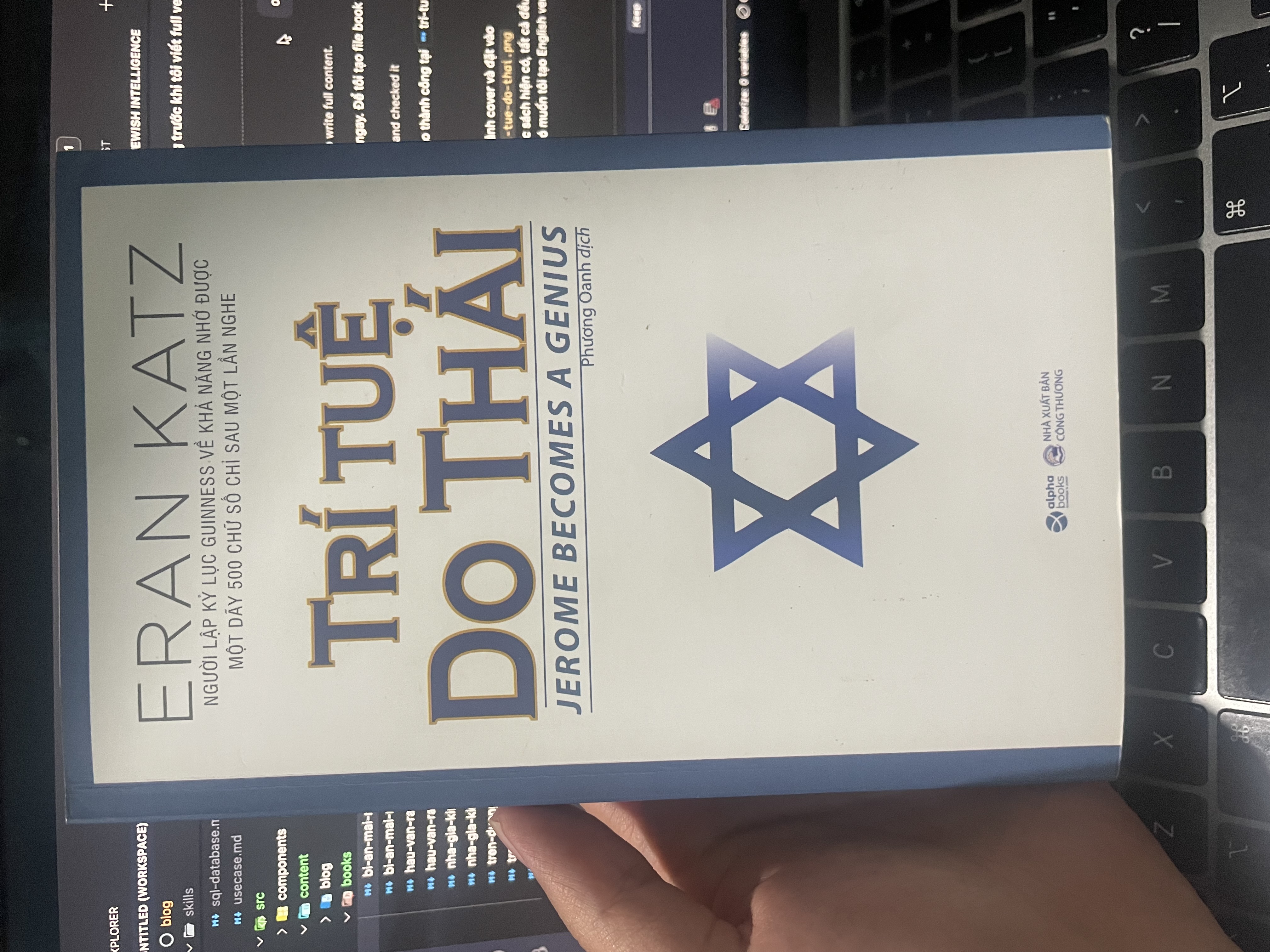
Jewish Intelligence
Eran Katz
"A deep dive into why Jewish people are considered the most intelligent - not genetics, but educational methodology. Read it 3 times, each revealing the gap between rote learning and real learning."
Jewish people comprise 0.2% of the world’s population, yet hold 22% of Nobel Prizes. This ratio isn’t coincidence, isn’t genetics - it’s the result of an educational system refined over thousands of years.
Jewish Intelligence by Eran Katz isn’t your typical self-help book with “10 tips to get smarter.” This is a deep analysis of Jewish learning culture - from how they read the Torah, how they debate, to how they memorize.
I’ve read this book 3 times. Each time, I understood more clearly the gap between “learning to remember” and “learning to understand” - and why many Asian education systems remain stuck in the former.
Why Are Jewish People the Most Intelligent Nation?
This question doesn’t stem from pride or prejudice. Here’s the data:
- 22% of Nobel Prizes belong to Jewish people (only 0.2% of world population)
- 30% of Forbes billionaires are Jewish
- Names like Einstein, Freud, Marx, Zuckerberg all have Jewish roots
Many think it’s hereditary. Wrong. Eran Katz proves that Jewish intelligence comes from educational culture, not genes.
Culture of Asking Questions Instead of Giving Answers
In the Torah (Jewish Bible), there are no absolute truths. Everything can be questioned, debated, challenged.
When a Jewish child comes home from school, parents don’t ask: “What did you learn today?”
They ask: “What questions did you ask today?”
This difference creates critical thinking from childhood. Jewish children are encouraged to challenge teachers, debate with parents, question everything - not out of disrespect, but because that’s the proper way to learn.
Learning Is Debate, Not Lecture
The primary Jewish learning method is called Hevruta (also spelled Chavrusa) - learning with a study partner, arguing loudly, with intonation, even fighting.
This isn’t “group study” as practiced in Vietnam (sitting silently, dividing tasks, working separately then combining results). Hevruta is intellectual combat: two people read the same passage, but debate its meaning, challenge each other, ask questions continuously.
Through this, knowledge isn’t “received into the head” but created through the thinking process.
Three Core Principles of Jewish Intelligence
Eran Katz summarizes the Jewish method into 3 simple but powerful principles:
1. Trust Your Own Memory
Jewish people don’t believe in “I don’t have a good memory.” They believe memory is a muscle - it can be trained.
The book tells of Jerome - an ordinary person with average memory. But after applying Jewish methods, Jerome could memorize hundreds of complex pieces of information simply by building “connection networks” instead of cramming.
The secret isn’t learning more, but learning the right way: connecting new information with old information, creating a knowledge network instead of scattered data.
2. Write Clearly on White Paper with Black Ink
“What is vague in the mind becomes clear on paper” - this is an iron rule of Jewish people.
When you write on paper:
- Thinking is forced to be clear - cannot be vague like in your head
- The brain processes more deeply - handwriting activates more brain regions than typing
- Knowledge is consolidated - writing is the strongest form of remembering
Jewish people don’t believe in “read once and remember.” They rewrite, summarize, draw diagrams - turning information into their own product.
3. Study Aloud, With Intonation, With Study Partner (Hevruta)
This is the strangest principle - and also the biggest shock when I first read this book.
Jewish people study standing up, in noisy environments like a bar.
Sounds absurd, right? We’re taught that studying requires silence, sitting straight, quiet environment. But Jewish people do the opposite:
- Study standing - keeps the body alert, better blood circulation
- Study in noise - brain must concentrate intensely, filter noise, so memory is deeper
- Read aloud with cheerful, playful intonation - turns learning into an emotional experience
Hevruta (learning with study partner) requires:
- Reading aloud - activates vision, hearing, and movement
- Using strange, exaggerated intonation - knowledge attached to emotion lasts longer
- Arguing loudly with study partner - intellectual collision for deep understanding
The first time I read this section, I thought the author was joking. But this is a method that has existed for thousands of years in Jewish culture. In Yeshiva schools (Jewish schools), students stand, shout loudly, argue noisily - and that’s how they study Torah.
Sounds chaotic, but this very “chaos” makes the brain work at maximum intensity.
Jewish vs Vietnamese Education: The Thinking Gap
This is the hardest section to write, but also the most important reflection this book gave me.
Vietnam: Learning to Remember, Remembering to Test
Vietnamese education system is built on rote learning and memorization:
- Teacher stands on podium, students sit silently listening
- Correct answer is already in the textbook - students just need to remember
- Questioning the teacher = disrespectful, challenging authority
- Group study = sitting silently, dividing tasks, working separately then combining
- Success = high test scores
Result: Vietnamese students excel at tests, at memorizing formulas, but weak in critical thinking, creativity, and solving real problems.
I was once a product of this system. Memorized for tests, forgot everything after exams. Knowledge wasn’t mine - it was just temporary data in my head.
Jewish: Learning to Understand, Understanding to Ask Deeper Questions
Jewish education system is completely opposite:
- No absolute answers - everything can be debated
- Questioning the teacher = good student, thinking deeply
- Group study = noisy debate, challenging each other, reading aloud with intonation
- Success = asking good questions, independent thinking
Result: 22% of Nobel Prizes, 30% of Forbes billionaires, leading in innovation and startups (Israel - 2nd startup nation after USA).
Why Is It Hard to Apply Jewish Methods in Vietnam?
Not because we’re less intelligent. But because of culture and system.
Cultural barriers:
- East Asian culture respects authority - questioning = disrespectful
- Fear of being wrong, fear of standing out, fear of being different
- “Silence is golden” - must study quietly, talking too much is annoying
System barriers:
- Classes of 40-50 students - cannot debate effectively
- Teachers not trained in critical thinking pedagogy
- Curriculum too heavy on theory, light on practice
- Evaluation by scores - encourages rote learning, not thinking
Reading this book, I increasingly see why Jewish students in America often outperform Asian students, despite both being hardworking. Not IQ, but the learning method trained from childhood.
The Book I Read 3 Times
In my life, I’ve read many self-help books. But “Jewish Intelligence” is the only one I read 3 times - not because it’s entertaining, but because each reading brought deeper understanding.
1st Reading (2022): “This Method Is Too Strange, Cannot Apply”
First time reading, I was shocked by things like:
- Study standing? Study in noise? Study with strange intonation?
- Arguing with teacher = good student? Sounds absurd
I finished reading and thought: “This only works for Jewish people. In Vietnam, people would laugh at you.”
But the story of Jerome - from ordinary person becoming memory master - kept penetrating my mind. If Jerome could do it, why not try?
2nd Reading (Late 2022): “Ah, Culture Determines Thinking”
Second time reading, I was no longer shocked. I started comparing with how I studied for 12 years.
I realized:
- I learned to remember, not to understand
- I was afraid to ask “stupid” questions in class
- I studied alone, silently, sitting straight - like a robot
This wasn’t my fault, but the system’s fault. The system shaped my thinking from childhood - and only now could I see it.
From this reading, I started small experiments:
- Study with friends, debate instead of sitting silently
- Write summaries by hand instead of highlighting
- Ask questions instead of just listening
3rd Reading (2024): “Intelligence Isn’t Innate”
Third time reading, I’d had 2 years practicing Jewish methods (though imperfectly). And now I understood the deepest message of the book:
Intelligence isn’t innate. It comes from method.
Jewish people aren’t smarter than Vietnamese in terms of genes. But they have a better education system - one that encourages questioning, debating, critical thinking.
Jerome in the book is evidence. Eran Katz too. They weren’t geniuses from childhood, but they trained their intelligence with the right method.
And if they could do it, anyone can - even in Vietnamese educational context.
Limitations of the Book
No book is perfect, and “Jewish Intelligence” is no exception.
Early sections are a bit long-winded: The author dedicates many pages to brain science, Jewish cultural history - might be boring for those not interested in the topic. I skipped a few pages on first reading.
Hard to apply in Vietnamese context: The Hevruta method (noisy studying, debating) is very difficult to implement in Vietnam. If you read aloud, argue in the library or café, people will look at you strangely.
But these limitations don’t diminish the book’s value. What matters is understanding the principles, then adapting to your own circumstances.
Personal Rating: 5/5 Stars
I give this 5/5 stars not because it’s perfect, but because it changed how I view learning and intelligence.
Before reading this book, I thought:
- Smart people have high IQ from childhood
- Learning = sitting quietly, reading books, taking notes, testing
After reading 3 times, I understand:
- Intelligence is the result of method, not genes
- Learning = asking questions, debating, connecting knowledge
This is the most valuable book on learning skills I’ve ever read - not because it gives tips, but because it changes mindset.
Who Should Read This Book?
- Students currently learning by rote and wanting to change methods
- Working professionals wanting to improve memory and information processing
- Parents wanting to understand how to educate children with critical thinking methods
- Teachers wanting to shift from “transmitting knowledge” to “inspiring thinking”
Don’t expect this book to give you 10 quick tips to get smarter. This is a book about culture, educational philosophy, and methods of training intelligence - needs slow reading, reflection, and action.
Final Words: The Fortune of Intelligence
Remember the saying from “Hậu vận rất đắt”? Your fortune is expensive, don’t waste it.
Intelligence is the same. You can choose to learn the old way - rote learning, forget after tests. Or you can choose to learn the Jewish way - learn to understand, understand to ask deeper questions.
Which method you choose will determine who you become in 10 years.
I’ve chosen. What about you?