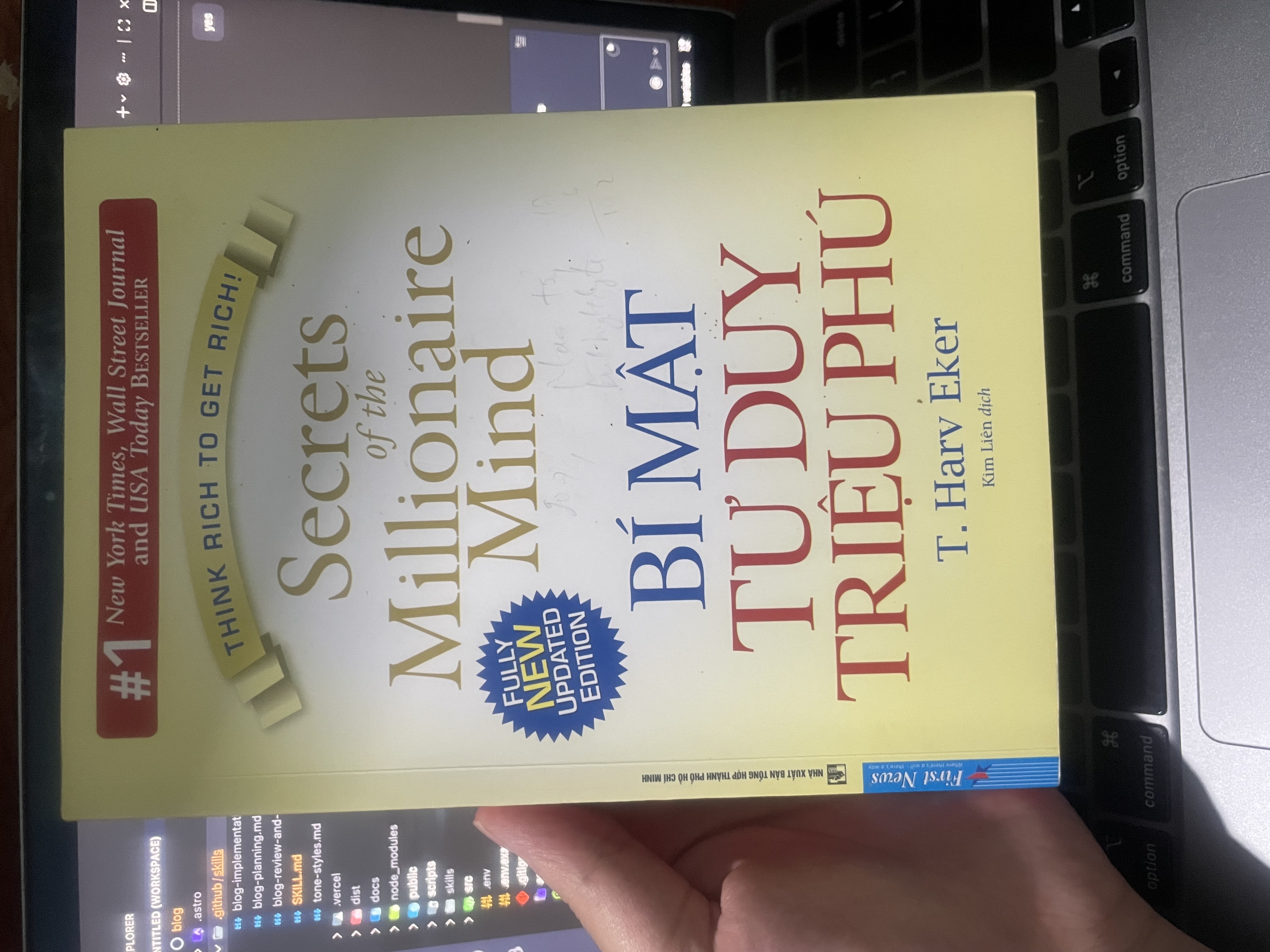
Secrets of the Millionaire Mind
T. Harv Eker
"A fundamental book that changes how you perceive money. It's not just about superficial wealth advice; Eker digs deep into the 'financial blueprint' to help change things from the roots."
I picked up Secrets of the Millionaire Mind by T. Harv Eker expecting practical money tips, but what stayed with me most was how it challenged my default beliefs about money.
Core Content
The book is split into two clear parts:
- Part I: Explains your “money blueprint,” shaped by childhood beliefs, family messages, and early experiences.
- Part II: Introduces 17 “Wealth Files,” comparing rich and poor patterns of thinking in a very direct way.
What makes it compelling is Eker’s personal story—from failure to financial success—which makes the idea of “change your mindset first, then your results” feel real rather than abstract.
The 17 Wealth Files
This is the section I found most actionable: 17 mindset contrasts between rich and poor thinking.
- Rich people believe “I create my life.” – Poor people believe “Life happens to me.”
- Rich people play the money game to win. – Poor people play the money game not to lose.
- Rich people are committed to being rich. – Poor people want to be rich.
- Rich people focus on opportunities. – Poor people focus on obstacles.
- Rich people admire other rich and successful people. – Poor people resent rich and successful people.
- Rich people think big. – Poor people think small.
- Rich people are willing to promote themselves. – Poor people think negatively about selling and promotion.
- Rich people are bigger than their problems. – Poor people are smaller than their problems.
- Rich people act in spite of fear. – Poor people let fear stop them.
- Rich people work smart, not just hard. – Poor people work hard for their money.
- Rich people choose to get paid based on results. – Poor people choose to get paid based on time.
- Rich people think “both.” – Poor people think “either/or.”
- Rich people focus on net worth. – Poor people focus on working income.
- Rich people manage their money well. – Poor people mismanage their money.
- Rich people have their money work hard for them. – Poor people work hard for their money.
- Rich people constantly learn and grow. – Poor people think they already know.
- Rich people choose lasting wealth. – Poor people choose temporary comfort.
Strengths of the Book
Eker’s tone is approachable and often humorous, almost like a live coaching session. More importantly, the book goes beyond theory and gives practical exercises you can apply immediately—from tracking spending habits to spotting opportunities to increase income.
Who is this for?
In my view, this book is a strong fit for:
- Anyone starting to learn about personal finance.
- Those who feel “stuck” financially despite putting in a lot of effort.
- Anyone looking to build a sustainable wealth mindset, not just for finance but for personal happiness.
Personal takeaway: The biggest shift this book gave me wasn’t a “get-rich” tactic, but a deeper sense of ownership over my financial choices. If you want to reset your money mindset at the root, this is a practical and motivating place to start.